
Korean alphabet guide
Learn the Korean alphabet.
Hangul has 40 letters and a logic you can see. This page walks through every one of them — how they sound, how they stack into syllables, and the rules that make spoken Korean differ from written Korean.

앱SKAI Hangul
Play your way through Hangul.
SKAI Hangul takes you from your first vowel to batchim through short games and a story. Free on both stores.



A path through it, in order.
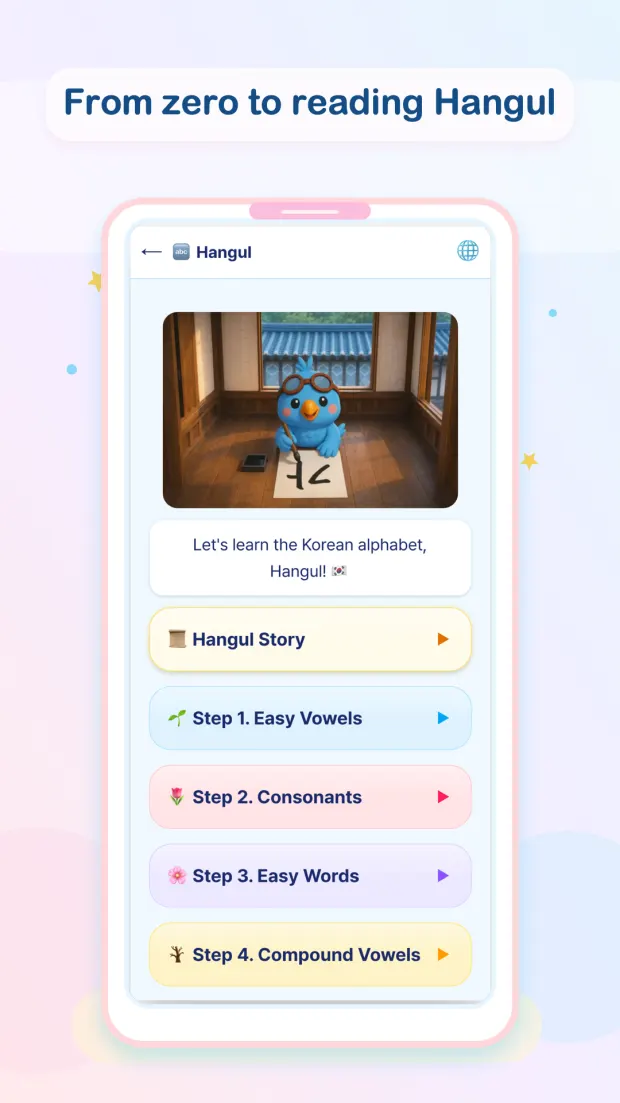
SKAI Hangul teaches the letters in this order, shaped around the parts learners actually find hard.
-
01
Easy vowels
The 10 basic vowel letters, starting with the six simplest shapes.
-
02
Consonants
All 19 consonant sounds — plain, aspirated and tense — paired with vowels you already know.
-
03
Easy words
Your first real Korean words, built from the letters you have learned so far.
-
04
Compound vowels
The 11 combined vowels, including the groups that share one sound.
-
05
Batchim
Final consonants: the soft ones, the seven representative sounds, and double batchim.
-
06
Hangul master
A final mastery round, and a certificate when you finish.
The short answer
Hangul (한글) is the Korean alphabet — the writing system, not the language. It has 24 basic letters: 14 consonants and 10 vowels. Add the 5 tense consonants and 11 compound vowels built from those basics and you get 40 letters in total. Letters are packed into square blocks, one block per syllable. Learners commonly report recognising the letters within a few days; reading accurately takes longer, because of the final-consonant rules.
모음Vowels
The six simple vowels.
Every Korean vowel is built from these. The pairs that give learners trouble — ㅓ/ㅗ and ㅡ/ㅜ — differ only in whether your lips are rounded.
- ㅏ a
- ㅓ eo
- ㅗ o
- ㅜ u
- ㅡ eu
- ㅣ i
Add a stroke, add a 'y'.
One extra short stroke on a vowel adds a 'y' sound in front of it. This is the featural logic of Hangul at work.
- ㅑ ya
- ㅕ yeo
- ㅛ yo
- ㅠ yu
자음Consonants
The 14 consonants.
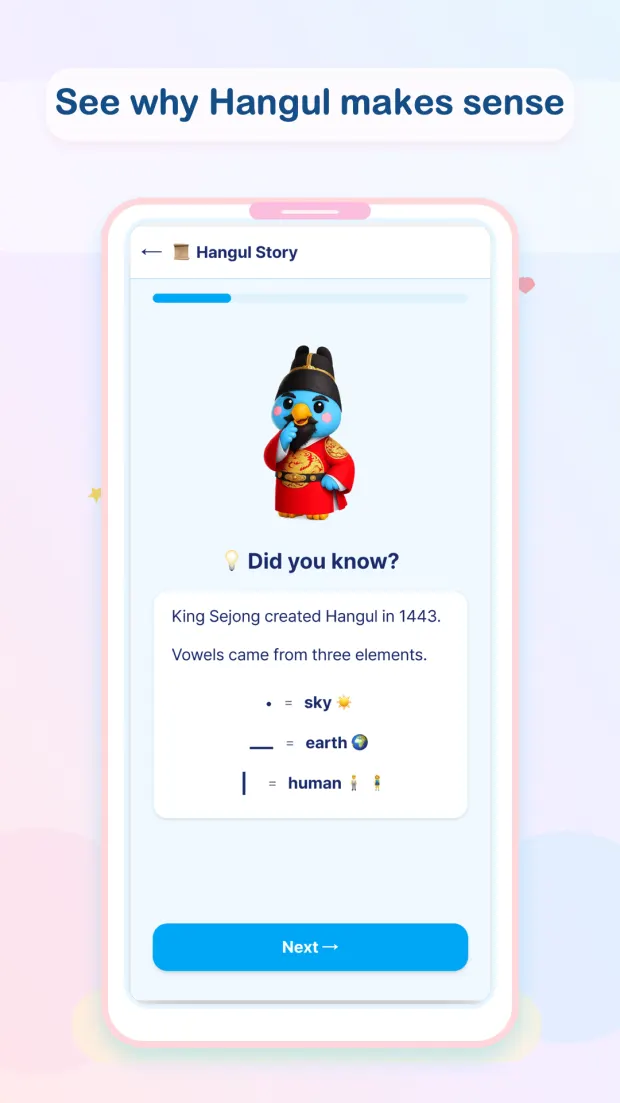
Five of them were drawn from the speech organs: ㄱ the tongue root closing the throat, ㄴ the tongue against the upper gum ridge, ㅁ the shape of the mouth, ㅅ a tooth, ㅇ the throat. The rest are built from those five by adding strokes — ㅋ from ㄱ, ㄷ and ㅌ from ㄴ, ㅂ and ㅍ from ㅁ, ㅈ and ㅊ from ㅅ, ㅎ from ㅇ.
- ㄱ g / k
- ㄴ n
- ㄷ d / t
- ㄹ r / l
- ㅁ m
- ㅂ b / p
- ㅅ s
- ㅇ — / ng
- ㅈ j
- ㅊ ch
- ㅋ k
- ㅌ t
- ㅍ p
- ㅎ h
Double consonants.
Five more, written as doubled letters — but they are not said twice, and they are not said louder. Korean calls them 경음, or tense consonants, and they are made by tightening the throat and letting almost no air out.
- ㄲ kk
- ㄸ tt
- ㅃ pp
- ㅆ ss
- ㅉ jj
Compound vowels.
Eleven vowels made by combining the basics. Several of them share one sound in everyday modern Korean — ㅐ and ㅔ are identical for most speakers, as are ㅙ, ㅞ and ㅚ. When two letters sound the same, the thing to learn is the spelling, not the sound.
- ㅐ ae
- ㅔ e
- ㅒ yae
- ㅖ ye
- ㅘ wa
- ㅝ wo
- ㅟ wi
- ㅢ ui
- ㅙ wae
- ㅞ we
- ㅚ oe
글자 블록Syllable blocks
Letters stack into squares.
Korean is not written in a straight line. Each syllable is packed into its own square block, and every block needs a consonant first and a vowel second. Vertical vowels (ㅏ ㅓ ㅣ) sit to the right of the consonant; horizontal vowels (ㅗ ㅜ ㅡ) sit underneath it. A final consonant, when there is one, goes at the bottom.
When a syllable begins with a vowel sound, the silent ㅇ fills the consonant slot — which is why 'a' is written 아 and never ㅏ on its own.
받침Batchim
The seven batchim sounds.
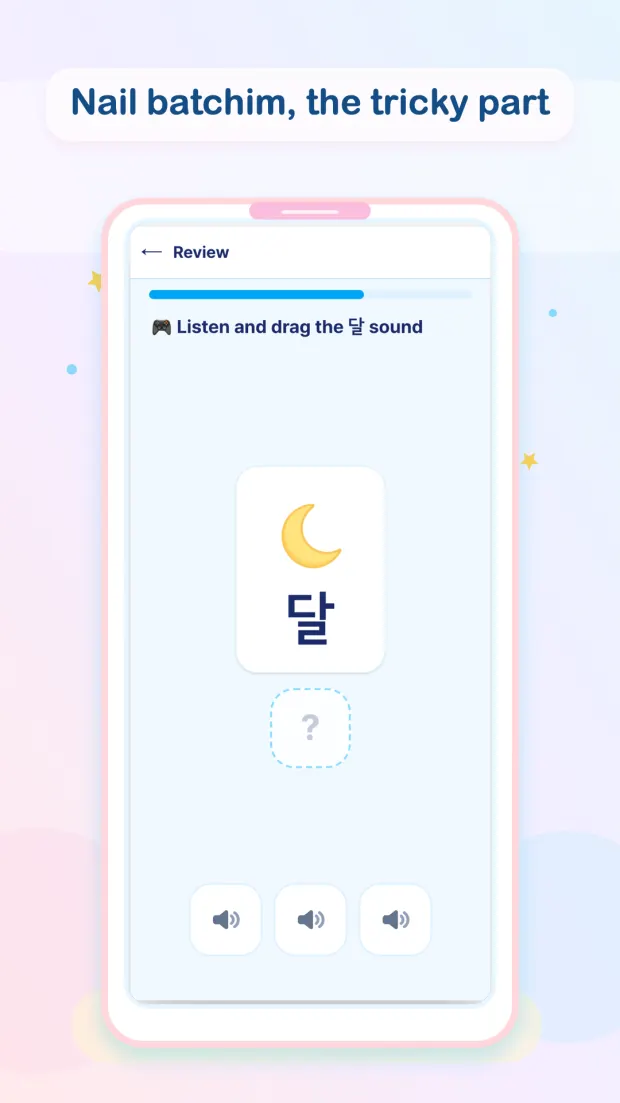
The final consonant at the bottom of a block is called batchim. This is where most learners slow down: many different letters collapse into the same seven sounds, and the final consonant is stopped rather than released.
| Sound | Romanized | Letters that make it | Example |
|---|---|---|---|
| ㄱ | k | ㄱ ㅋ ㄲ | 책 (chaek) — book |
| ㄴ | n | ㄴ | 산 (san) — mountain |
| ㄷ | t | ㄷ ㅅ ㅆ ㅈ ㅊ ㅌ | 옷 (ot) — clothes |
| ㄹ | l | ㄹ | 물 (mul) — water |
| ㅁ | m | ㅁ | 밤 (bam) — night |
| ㅂ | p | ㅂ ㅍ | 밥 (bap) — rice, a meal |
| ㅇ | ng | ㅇ | 강 (gang) — river |
This is why 낫, 낮 and 낯 — three different words with three different final letters — are all pronounced the same. The spelling still matters, though: the original consonant reappears as soon as a vowel follows it, because it slides into the next syllable.
소리 규칙Sound rules
Why you can read Korean but not catch it.
Written Korean does not map one-to-one onto spoken Korean. When syllables meet, sounds change. These rules are the last step of learning to read, and the first step of learning to listen.
Learn it by playing, not by memorising.
SKAI Hangul takes you from your first vowel to batchim and sound rules through short games. Free on both stores.